KFOG takes to the high seas viaChannel 292 on Sunday June 20th 2021 at 1200 utc (1 pm UK time) and on Saturday June 26th at 0900 utc (10 am UK time) on 6070 kHz. Expect tunes in a nautical style and “see the glimmer from a distant lighthouse, as the buoys ding and the (radio) waves crash onto the rocky shore. This is music from the mist!” as they say at KFOG HQ.
Expect a mix from One Deck Pete called “A mix from across the Pond” with tunes from Kiyoko, Honeychild & DJ Olive, BOATS, Robert Mellin and The Congo’s. Grab yourself a lifejacket and a shortwave radio and tune in. If the shortwave radio is a problem tune in here at the alloted time. If you haven’t a lifejacket we’re sorry but we can’t help you with that!
It’s been a while since we’ve heard about our friend (and musical collaborator) Paul Greenstein‘s garden in Melbourne, Australia. He’s sent us over a few pics and news of what he’s up to now. For around a year he’s been keeping bees.
“We started with a ‘nucleus’ hive, which is a small box with 5 frames. We’ve now grown to 3 full-sized boxes (supers), although we’ve packed the bees down into 2 boxes for the winter. For the bees, it’s about staying warm. From the beekeeper’s perspective, you want to make it easy for them to stay nice and toasty, and not to have to worry about heating a lot of empty space. Kind of like downsizing your house to save on the bills, except they keep warm by vibrating their flight muscles while keeping their wings still. Amazing little creatures.
We haven’t harvested any honey this time around, preferring to let the bees keep it for food during winter, building up a strong hive. We live very near a creek (basically a river, but not a very big one) – and there’s loads of stuff for bees to forage. Lots of Eucalypt trees, although there’s a particular type of Eucalypt called Stringybark or Messmate, which for some reason makes bees angry. Maybe they don’t like the way it smells. Hopefully they’ll avoid those and we won’t get stung by grumpy foragers…”
He also mentioned the subject of the last but one post about cicadas from Justin Patrick Moore:
“We get incredibly loud cicadas here – in fact they’ve been known to drown out conversation! Apparently the version we have here are called Greengrocer Cicadas, and can go up to 120 dB – louder than an ACDC gig. Our cats occasionally get fed up and swat them with a paw – they’ll go silent in shock for a few seconds, then start up again.”
Below is a pic of a Bramley apple that he’s put in as “You can’t get decent cooking apples over here!” We do like a cooking apple here especially in a crumble with custard! Do have a look at older posts about his garden here here and here.
And here’s a couple from Paul’s musical output, a lovely garden related tune called “Rose” that has a lovely ambient feel to it and one with a Jah Wobble type vibe called “White Blinds“, excellent stuff indeed!
As it says on his soundcloud “Sometimes inwards is the only way to go.” He and the bees are 100% correct! Cheers for the pictures Paul and keep us updated with how things are getting on!
Here’s a post from our good radio, gardening and music friend across the pond Justin Patrick Moore about some bugs that are about in his back yard in Cincinnati at the moment. We’ve never even heard of them over here!
The seventeen year cicadas are at it again. This generation of periodical cicadas has been dubbed Brood X. The periodical cicadas have the latin name of Magicicada septendecim, and have a really interesting life cycle. In southwestern Ohio they are of the kind that come out every seventeen years. These insects spend around 99.5% of their long life underground as nymphs, feeding on fluids from tree roots in the eastern United States. In the spring of their 17th year the mature cicada emerges between late April and early June at a given locality, depending on temperature, and when they come out, they are usually in huge numbers. They’ve been creeping out of the ground slowly the past few weeks, but this past Saturday was the first day I saw a bunch of them. The temperature of the soil has to reach a certain temperature before they really start coming out of the ground, making little holes that they then emerge from. The soil has to get about 17.9 °C (64 °F) before they are ready to get busy with each other propagating a new brood which is what they will spend the next four to six weeks doing. To attract a mate the males of the species have to make a long sonorous drone, that gets louder in the neighborhood as more and more cicadas come out of the ground and start flying and flitting about. Mostly they like to hang out on trees. Apparently in the eastern U.S. where these little buggers live, billions are going to emerge. That’s a lot of cicadas.
This is the third time in my life that I’ve seen the cicada’s. The first time was when I was a kid in 1987. Unfortunately as a kid I was rather cruel to these little things. Hopefully I’ve already worked off the karma I generated by being mean to bugs. (Be nice to the cicadas as they don’t hurt nobody and help aerate the soil!) The next time was in 2004 and I made a recording of them to use in the drone & experimental ambient music I am so fond of. I still have the recording but don’t know if I ever actually made a track with the sounds. That first time around too, there was a local pizzeria called Snappy Tomato Pizza. They made a jingle for Snappy Cicada Pizza that has stuck in my head ever since I heard it. They had a promotion that if anyone came in and ate a cicada they’d get a free pizza. Apparently they also had them to use as a pizza topping – but I think that was just part of their marketing ploy that has now become local folklore. Hear the jingle here.
According to a story I saw on NPR some of these cicadas are going to go into a sexual hyperdrive caused by a fungus that is similar to ones found in psychedelic mushrooms. It’s a trippy time of year over here! From: https://www.npr.org/2021/05/18/997998920/the-fungus-thats-making-cicadas-sex-crazy ( It’s so weird!) “Kasson, who has been studying Massospora for about five years, says just before the cicadas rise from the ground, the spores of the fungus start to infect the bug. Once it’s above ground and starts to shed its skin to become an adult, its butt falls off. Then a “white plug of fungus” starts to grow in its place.
A “white plug of fungus” seen in cicadas infected by Massospora. Matt Kasson “It looks as if the backside of the cicada is being replaced either by chalk or by like one of those nubby middle school erasers,” Kasson says.
The insects have no idea what’s happening. The fungus, however, is “pulling the strings” and making the cicadas want to mate with everyone.
Males that are infected will continue to mate with females, but they’ll also pretend to be females so they can spread the fungus to even more partners.
“It’s sexually transmissible,” Kasson tells NPR. “It’s a failed mating attempt, of course, because there’s no genitalia back there.”
The fungus causes different reactions in different types of cicadas. Periodical cicadas, which take more than a decade between appearances, get sex crazy from cathinone. In yearly cicadas, the fungus makes them instead become hypersexual from psilocybin — the same chemical found in psychedelic mushrooms. Kasson estimates Massospora probably infects fewer than 5% of cicadas. And as far as he knows, the bugs are not in any pain.
“Everybody’s having a good time while they’re infected,” he says. “So I don’t imagine there’s much pain — maybe a desire to listen to the Grateful Dead or something like that, but no pain.”
Cicada exoskeletons on lavender
Thanks very much Justin for the interesting piece and he also mentions to have a look at a blog post from a nature sound recordist in Ohio about the sounds the Cicadas make… and there’s lots of pictures. Have a look and listen here.
It’s been a bit of doom and gloom for the last few posts what with the bad weather so here’s a couple of uplifting things seen this morning. Firstly the first poppy of the season opening up, it may be small but it’s a lovely red!
And this little seedling (below) will hopefully will be supplying us with some purple srouting broccoli if all goes well. Roll on full days of sunshine eh?
Here’s some pictures to convey how bad the weather was yesterday around 5pm in London town. It started as a downpour, then heavier rain and then mad hail! To say it was chucking it down was an understatement. A fast flowing stream appearing under the back gate from the drive and then the hail built up at the start of the lawn and it’s still there now.
Watch those seedlings. We may not be having frosty nights but heavy rain and hail can be a pain. One good thing with all of this rain is that the pond is filling up. That makes a change!
We spent another couple of hours yesterday “tipping around with a hoe” as they used to say at the council and sorting out what’s what, now the new fence is in. As we cleared the side bed the day before we now can see what can go where.
At the bed at the bottom of the garden (pic above top) are a couple of cardoons that are now on their third year now after getting them originally from Shannon’s knowing nothing too much about the plant. I mean we don’t now that much about them now apart from the plants soar up to seven feet high and their thistle-like flowers attract bees and all sorts of pollinators in droves.
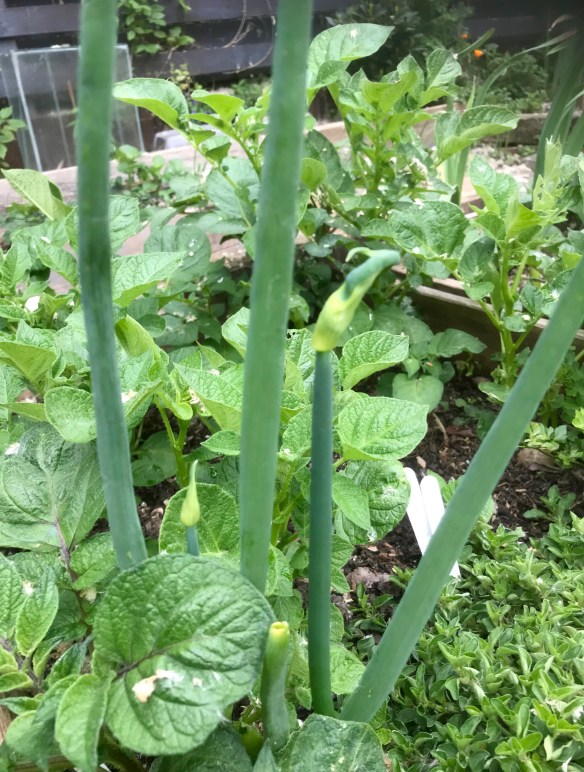
There’s also a globe artichoke next to the cardoonswhich we obtained after doing a swap with a mate at a local community garden for some egyptian walking onionbulbs (another “out there” plant). We’ll keep you posted on how they get on this year but do have a look at getting a cardoon or two if you fancy a bonkers looking plant!
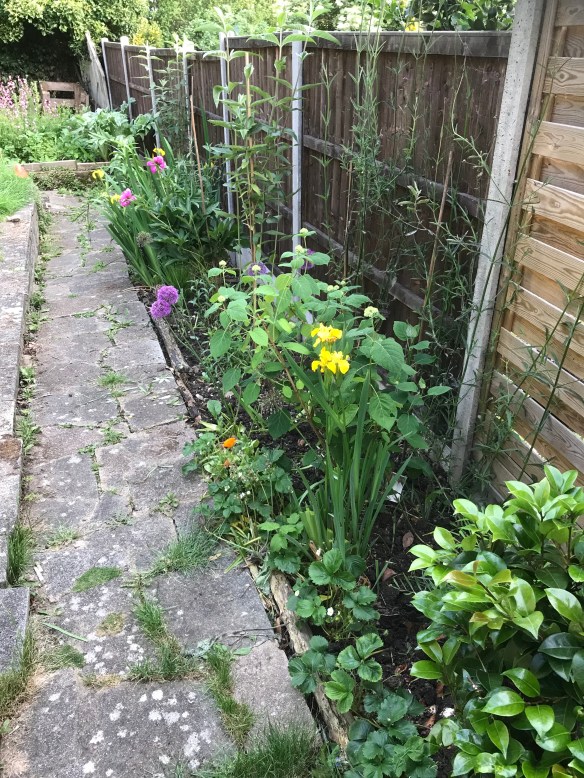
Well it’s the first day of spring today but it didn’t really feel like it weatherwise. We spent a couple of hours in the garden as the neighbours have put up a new fence so we cleared the bed on the side so we can actually see what plants are called for this year. We need a few shrubs so we’ll be researching them over the next few weeks.
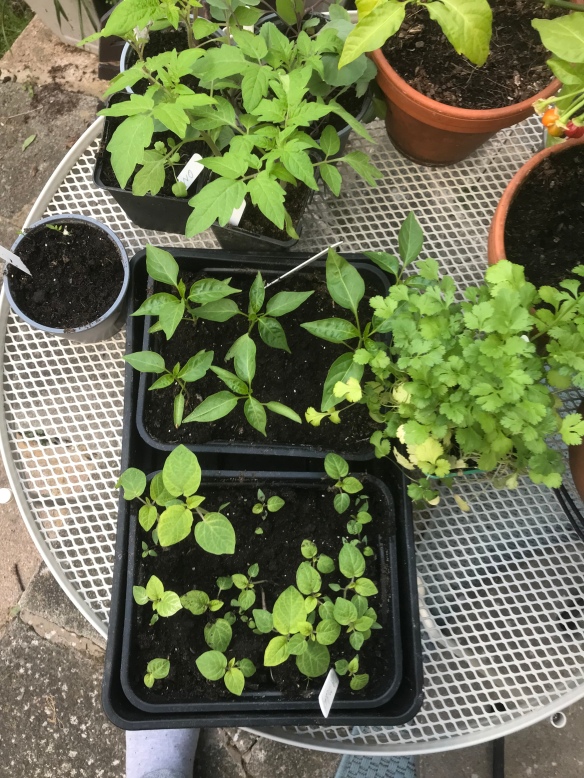
There’s seeds galore on the kitchen windowsill including two types of tomatoes and sweet peas, cut and come again lettuce, chillies and various herbs. It’s all about being prepared as the growing season is going to come around sooner than you think!
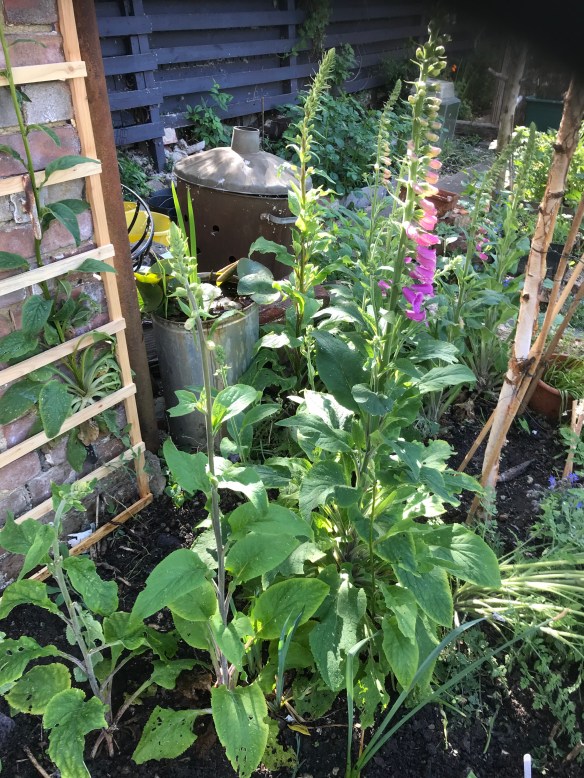
There was a load of clearing up going on down the bottom end of the garden too, lots of ivy to be cut back and we found a nice pile of very dry clippings from months ago. So to end a good couple of hours in the garden we christened our fairly newly acquired incinerator, cheers Marc! It’s been a while since we’ve had a fire and we’ve forgotten how nice it is to sit around a burning bright dustbin feeling the warmth. Hands up who loves a garden incinerator!
We go up another tier level this week, how are we going to cope with another lockdown? You can’t really go out in the garden as it’s a bit wet even though there’s been some warmer weather promised later this week. One job we will do is to get some gnat-free herb plants going on the kitchen windowsill after a summer of constant clouds of fungus gnats on our old pots. We’ve watered from the bottom and put up sticky traps and now going to admit defeat and starting again from scratch. More about the gnats and how to protect against them here.
We took some advice from the folks at Shannon’s and bought some indoor houseplant potting mix which should be free of any gnat’s eggs, put the old plants outside and give the actual pots a good clean with some disinfectant and then rinsed them through a few times for luck. It’s a bit early to be sowing anything really serious but we may start off a bit of basil (above: a few packs of seeds bought off ebay the other week) off in a pot with a see-through plastic bag on the top as a temporary greenhouse. As soon as the seeds show signs of propagation we’ll take the plastic off as to stop any damping off occurring.
Next summer we may be experiencing “a new normal” in the kitchen (ie. without clouds of gnats flying about or those sticky traps that don’t look too nice with lots of dead flies on them!)
Wow, it’s December can you believe? No wonder it’s freezing out there and the rest of the week looks like it’s going to be getting colder. We’ve heard from our gardening pals in Cincinnati (Cheers Justin!) and Freiberg, Germany (Cheers Jazz’min) where they’ve had their first dusting of snow so I doubt it won’t be long until we’ll get some.
Those dahlias were still looking fine last weekend but we reckon it won’t be long till the frost comes and blackens the plants when it will be time again to dig them all up and stick them somewhere frost free and dry for the rest of the winter, keeping an eye out for any rotting or mouldy tubers while they’re in storage.
We can’t complain as those spikey orange ones have been great this year, flowering right up until we last looked so going to the effort of digging them up and storing them indoors is a small price to pay for a few more years of the same.
And the nice plastic looking pink variety we were given this year was great too (cheers Marc).
And the beds in front of the Dad corner (that has been productive this year thanks to the new raised beds) have been tidied up a bit and now ready for the winter. In the pic you will notice a couple of cabbage stalks that we left when we cut the leaves off them. Not sure if it will happen over the winter but usually when you cut them off like that, the leaves grow back again. Value for money or what?
The bed at the bottom of the garden is always a bit of a problem as it only gets sunlight in the late afternoon. At the present moment the nasturtiums have taken over and so has the borage behind them. We haven’t had a hard frost yet so it’s looking a little wild to say the least!
If you can remember we were going to “rest” the bed and fill it with the Thompson and MorganBeneficial Flower seeds mix then COVID 19 came along. We were so fed up that one of the local shops had a 3 potato per person rule we put in a couple of rows of spuds plus some onions and broad beans there (see the bed in July here). After they were harvested in mid-August we gave the bed a good tidy up (here) and boy has it grown since!
The state of play at the moment is a Globe Artichoke root (1) we did a swap with a mate at a local community garden (for some Egyptian walking onion bulbs) is now starting to grow and the brilliant cardoons (2 and 3) we bought at Shannon’sa few years ago have starting sprouting again. Talk about value for money! And in the middle of the crazy nasturtiums are a couple of rows of autumn sown broad beans(4). When will the growing ever end?