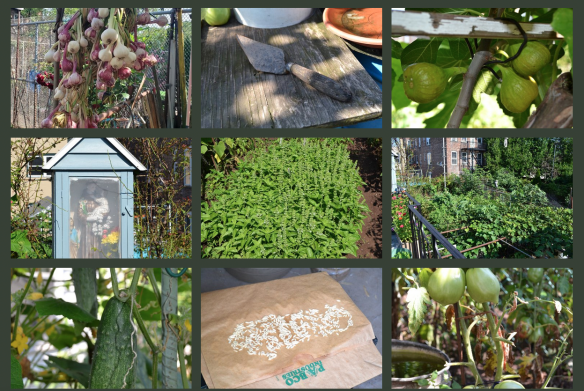
The sun’s out again and it’s 27°C and very dry in the garden this afternoon.
Last week we heard Christine Walkden on Gardener’s Question Time who said she likes to give her garden a good water with just a watering can and it can take her up to 2 hours at a time.
Since ditching the hose after watching a great special about conserving water on Gardener’s World a while ago it now takes us quite a while too just using a watering can without a rose on the top. We enjoy the slow ritual, the endless walks back and forth to the tap, making sure the soil gets a good soaking. We probably wouldn’t like it that way if we were going to catch a train but it’s a nice thing to do on an early morning on a day off work or in the later evening after a day of toil.
Is there such a thing as “meditative gardening”? There was a lot of staring into space with one foot on a garden fork when we worked at the council so it may have been around for years.
Talking of meditative gardening, there’s a great horticultural themed set from Monster Rally (we have a feeling that someone may have mentioned this to us before, our mates Gerry Hectic, DJ Frederick or Justin Patrick Moore perhaps?) called Botanica Dream. It’s full of some lovely downtempo business and at the moment the track above is our favourite but they’re all excellent.
And here’s a promo from the Skybird Council Gardeners Association for The Scented Garden radio show for you all to enjoy.
And an episode of The Scented Garden from earlier this year for your gardening/listening pleasure. Tune in, turn on and sit yourself in the middle of a flower bed preferably and enjoy the flowers.
Cheers to our good music/gardening/radio friend Justin Patrick Moore for sending us some great reading on Hugelkultur, this time on the greatly named Druids Garden (which has no affiliation to Ken Barlow sadly) site here.
We’d never even heard of the system before he told us about it a while ago but it’s looks well interesting and if you can get your hands on some logs, you’re in!
We’ve been a bit busy in the garden making good use of the lovely weather we’ve been having hence no new posts until now. Today has started gloomy and we’re expected to have a couple of days of this until the weekend when it brightens up again which is great news.
We heard from our good friend across the pond Justin Patrick Moore who has started a new project, something that is brand new to us here at Weeds. It’s a hugelkultur bed. As it says online: “Hugelkultur is a centuries-old, traditional way of building a garden bed from rotten logs and plant debris. These mound shapes are created by marking out an area for a raised bed, clearing the land, and then heaping up woody material (that’s ideally already partially rotted) topped with compost and soil.” http://www.almanac.com
More info here on this different sort of raised bed that made us think initially of the Victorian hot beds. Best of luck with that Justin, do let us know how you get on with it as it sounds great and looks good too!
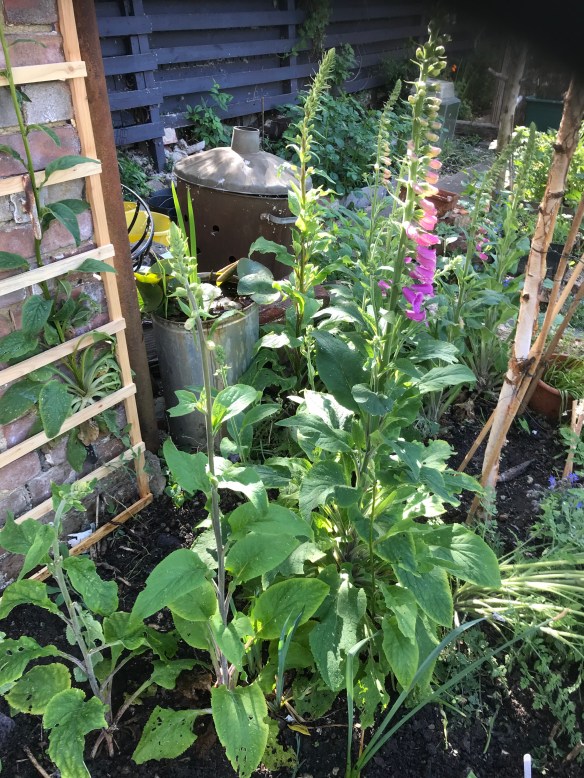
A couple of years ago a good friend gave us a couple of foxglove plants and they’ve multiplied and starting to come alive this year. Self seeded plants are sometimes a pain (in the case of spuds left in the ground or weeds) but these foxgloves are brilliant, even the one coming out of the brickwork on the garage.
The raised beds by the Dad Corner are starting to burst into life. The seed potatoes that were put in extra early are starting to grow and the overwintered garlic in the 2nd raised bed on the right are well on their way. Shame we didn’t have much luck with the shallots which just withered away. Remember we’re still in May and there’s reports of the odd unexpected frosts about so still keep an eye on the weather forecast for those cold nights and keep those old net curtains handy!
In the wild bit at the bottom which doesn’t get much light where’s there’s a row of spuds, cardoons and some wildflower mix from those beebombs and the odd assortment of cheap seed packets is started to look a bit “wild” instead of looking a bit untended. We’re trying to get it looking wild like the beds at the Horniman’s Gardens (below) which’ll take a few years and a bit of effort but it’s worth trying!
We’ve been out of the game over the last week and a bit due to catching the dreaded lurgy. We haven’t been able to do that much in the garden but look forward to being out there again once we feel a bit better and the great weather from last week returns.
Thanks to our good friend Justin Patrick Moore for reminding us of this Japanese ambient classic above from Haruomi Hosono – Talking. It’s a whole 15 minutes with a repeating motif not unlike a shortwave Interval Signal. Wonderful.
And talking of Interval Signals here’s a track we haven’t posted up in a while which is a favourite of ours from from Holland’sRephazer. If you love a bit of ambient combined with some shortwave radio malarkey, you can’t go wrong here.
And here’s another one in a chilled out vein the very tripped out Green from HiroshiYoshimura. Here’s to getting back to some sort of health normality very soon.
Thanks to our good friend Justin Patrick Moore for sending over his recommendation of this lovely Balearic inspired Stages of Time EP by Coyote. There’s some nice stuff on the EP including the very individually sounding The Igigi Gods Dub but the best one for us is another one with a reggaeish vibe Look For The Way In which is a very chilled affair, something we need at the moment what with all the Storm Eunice warnings. We heard a warning over the radio to firmly secure any trampolines in the back garden, it may be a good idea. See you the other side and batten down the hatches!
Big thanks to Stuart and all at Cities and Memoryfor their Shortwave Transmissionsproject that is released today, what is World Radio Day 2022. Cities and Memory teamed up with The Shortwave Radio Archive (Cheers Thomas!) with some rare recordings from the history of shortwave radio from all over the globe to remix. The excellent compilation on their bandcamp site here features some of the great compositions received including a favourite of ours from Grey Frequency called Chimes (Rai Internazionale).
Big shout to our good friend on the other side of the world Paul Greenstein for his contribution to the project called Another Universe. Like he says on the C&M site “Like the narrators, I have a fondness for all things space, astrophysics and the big questions like: is the Universe going to end, what are black holes, and why does Surf Guitar sound dangerous?”
And to our gardening/music/shortwave mate across the pond, Justin Patrick Moore for his track Squatters and unwanted insects of the Malayan Revolution.
And here’s one from our own correspondents Jazz’min Tutum & Madtone with LP Livicate dedicated to the late great Upsetter.
Listen to all of the project here. The top player is the original sample and the one below it is the remix.
And also here’s Stuart talking about the project and playing some stuff from it on Resonance FM earlier today. #worldradioday #shortwavesnotdead
Big shout to our gardening friend Gerry Hectic who’s stripped his outdoor tomato plants and brought the fruits in on the kitchen windowsill. We love the jar idea!
We’ve got some on ours too and chucked a couple away this morning as they looked like they were going brownish and we didn’t want them to muck up the other tomatoes.
Also cheers to another gardening/music friend, from across the pond this time Justin Patrick Moore who has acquired some Austrian winter pea seeds. We’ve never heard of them before and they sound good.
We’ve read “The greens taste like sweet sugar snap peas, but have the texture of lettuce” and they’re are also grown as a “Cover Crop” that’s one not for harvest but to cover the soil over the winter months to stop erosion and in the case of this plant to add nitrogen to the soil. May be a good idea to grow some either to eat or improve you garden! More on them here. Cheers to Gerry and Justin for the pics and info.
Big thanks to our good friend across the pond Justin Patrick Moore for sending us this picture of a volunteer (plants that self seed) zuchinni (aka courgette) that has come up on the compost heap. They thrive in rich soil so a compost heap is ideal. To say the plant is going mad is an understatement!
We only got one plant that we got from a new seed supplier we found out about this year and it’s really suprised us as it’s so large. We only sowed two, one got eaten by slugs and snails and this one has gone barmy, taking over the garden path. Only a couple of fruits so far and one of them was one of those forgotten ones which grew to a fair old size!
Looking at Justin’s site here we were reminded of this tune below and a great episode of Wireless Nights (Megahertz) from a while ago available to download here. An interesting listen if you like all that shortwave radio business! Cheers Justin!
Here’s a post from our good radio, gardening and music friend across the pond Justin Patrick Moore about some bugs that are about in his back yard in Cincinnati at the moment. We’ve never even heard of them over here!
The seventeen year cicadas are at it again. This generation of periodical cicadas has been dubbed Brood X. The periodical cicadas have the latin name of Magicicada septendecim, and have a really interesting life cycle. In southwestern Ohio they are of the kind that come out every seventeen years. These insects spend around 99.5% of their long life underground as nymphs, feeding on fluids from tree roots in the eastern United States. In the spring of their 17th year the mature cicada emerges between late April and early June at a given locality, depending on temperature, and when they come out, they are usually in huge numbers. They’ve been creeping out of the ground slowly the past few weeks, but this past Saturday was the first day I saw a bunch of them. The temperature of the soil has to reach a certain temperature before they really start coming out of the ground, making little holes that they then emerge from. The soil has to get about 17.9 °C (64 °F) before they are ready to get busy with each other propagating a new brood which is what they will spend the next four to six weeks doing. To attract a mate the males of the species have to make a long sonorous drone, that gets louder in the neighborhood as more and more cicadas come out of the ground and start flying and flitting about. Mostly they like to hang out on trees. Apparently in the eastern U.S. where these little buggers live, billions are going to emerge. That’s a lot of cicadas.
This is the third time in my life that I’ve seen the cicada’s. The first time was when I was a kid in 1987. Unfortunately as a kid I was rather cruel to these little things. Hopefully I’ve already worked off the karma I generated by being mean to bugs. (Be nice to the cicadas as they don’t hurt nobody and help aerate the soil!) The next time was in 2004 and I made a recording of them to use in the drone & experimental ambient music I am so fond of. I still have the recording but don’t know if I ever actually made a track with the sounds. That first time around too, there was a local pizzeria called Snappy Tomato Pizza. They made a jingle for Snappy Cicada Pizza that has stuck in my head ever since I heard it. They had a promotion that if anyone came in and ate a cicada they’d get a free pizza. Apparently they also had them to use as a pizza topping – but I think that was just part of their marketing ploy that has now become local folklore. Hear the jingle here.
According to a story I saw on NPR some of these cicadas are going to go into a sexual hyperdrive caused by a fungus that is similar to ones found in psychedelic mushrooms. It’s a trippy time of year over here! From: https://www.npr.org/2021/05/18/997998920/the-fungus-thats-making-cicadas-sex-crazy ( It’s so weird!) “Kasson, who has been studying Massospora for about five years, says just before the cicadas rise from the ground, the spores of the fungus start to infect the bug. Once it’s above ground and starts to shed its skin to become an adult, its butt falls off. Then a “white plug of fungus” starts to grow in its place.
A “white plug of fungus” seen in cicadas infected by Massospora. Matt Kasson “It looks as if the backside of the cicada is being replaced either by chalk or by like one of those nubby middle school erasers,” Kasson says.
The insects have no idea what’s happening. The fungus, however, is “pulling the strings” and making the cicadas want to mate with everyone.
Males that are infected will continue to mate with females, but they’ll also pretend to be females so they can spread the fungus to even more partners.
“It’s sexually transmissible,” Kasson tells NPR. “It’s a failed mating attempt, of course, because there’s no genitalia back there.”
The fungus causes different reactions in different types of cicadas. Periodical cicadas, which take more than a decade between appearances, get sex crazy from cathinone. In yearly cicadas, the fungus makes them instead become hypersexual from psilocybin — the same chemical found in psychedelic mushrooms. Kasson estimates Massospora probably infects fewer than 5% of cicadas. And as far as he knows, the bugs are not in any pain.
“Everybody’s having a good time while they’re infected,” he says. “So I don’t imagine there’s much pain — maybe a desire to listen to the Grateful Dead or something like that, but no pain.”
Cicada exoskeletons on lavender
Thanks very much Justin for the interesting piece and he also mentions to have a look at a blog post from a nature sound recordist in Ohio about the sounds the Cicadas make… and there’s lots of pictures. Have a look and listen here.