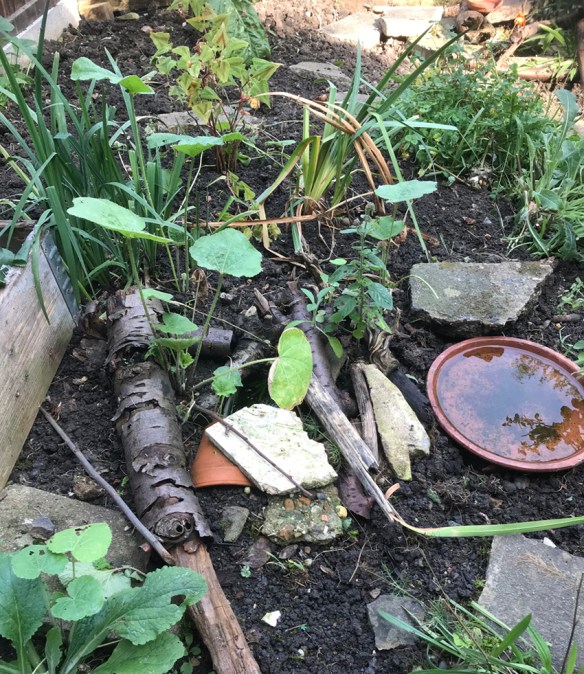
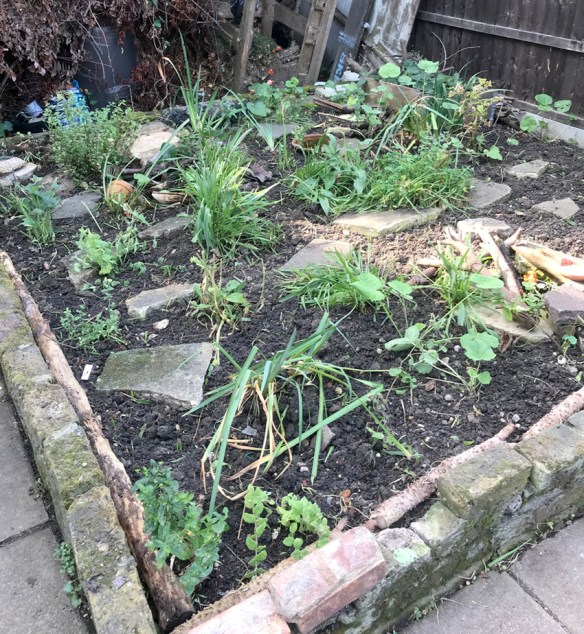
Early yesterday morning we decided to clear the “wild” part of the garden (below) as yes it is wild but it just looked a bit of a mess. We cleared out all the weeds and now it’s a little bit bare but we can imagine that won’t last long. We’re expecting some rain later this week so that mixed with some sunny periods will be the right conditions for a mad growth spurt.
Whilst having a cup of tea admiring our good work, we were visited by a fox quickly passing through, two birds including the Robin (top pic) and then a neighbour’s cat came in either for the birds or the bit of catmint we are growing near the pond. We remember years at Shannon’s someone telling us it will bring all the locals cats in. Perhaps they were right?
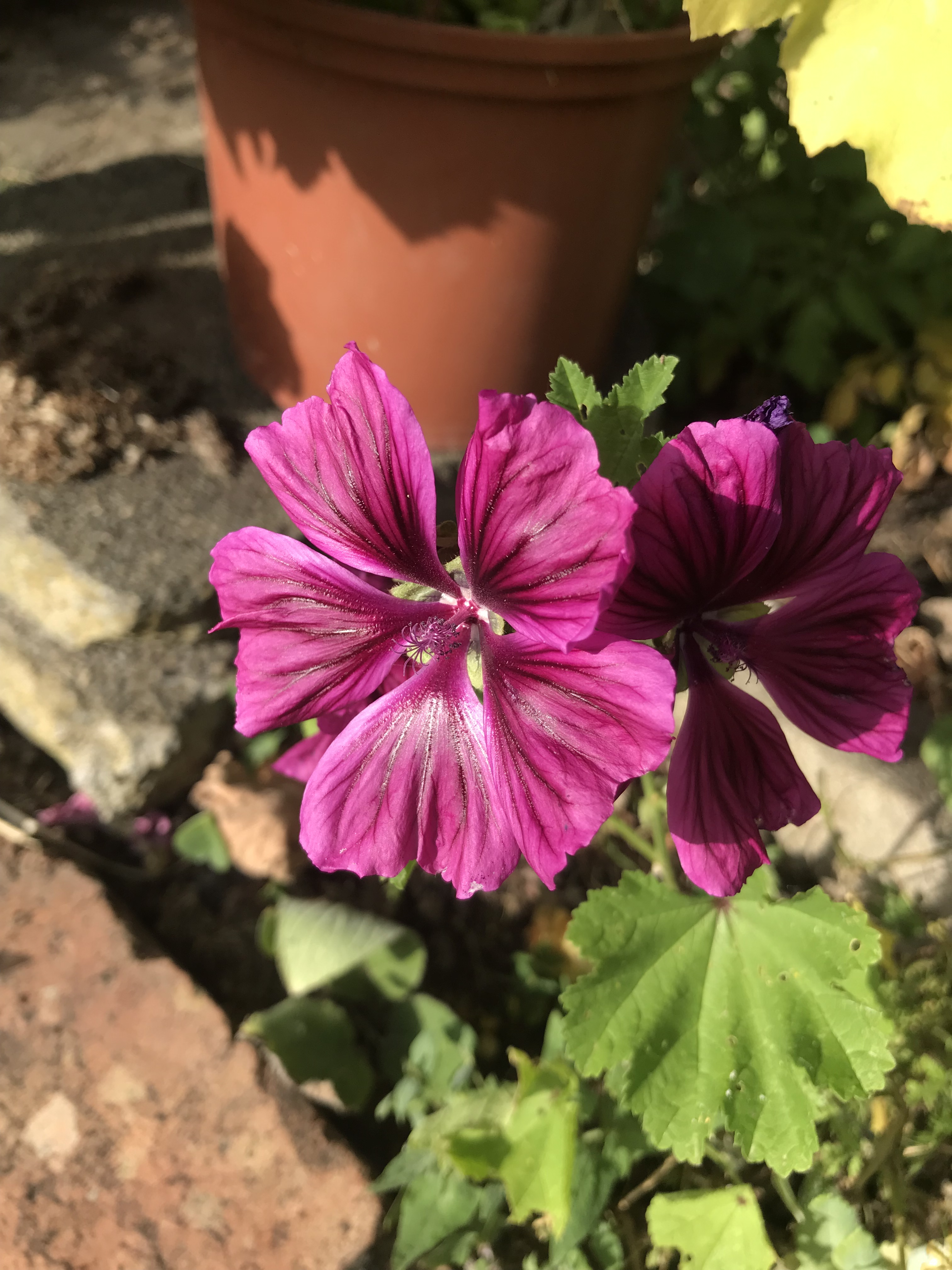
This afternoon wandering around the garden we saw some bees going to town on a salvia (above) and noticed this nice wild flower (below) which Plant.idsaid was a form of mallow.
If we have to thin plants out of the pond we sometimes put them in micro ponds we’ve dug into the ground in the wild bit at the bottom of the garden. This time here’s some water mint in an old M&S plant container. Waste not want not.
“Honey bees get all the headlines” so it says on this great bee hotel/bee Air B&B seen by Guys & St Thomas’ Hospital the other day.
We waited about in front of the accommodation for a few minutes waiting for some insect action but sadly didn’t see anything but it’s a great idea to have a bee hotel. When we got home we collected some hollow sticks and plant stalks and stuck them all in a nice pile at the back of the wild bit but it isn’t anything as smart as that one.
For more information on making a bee hotel/mansion/bungalow/two up two down and why it is important to have one take a look here.
Big shout to our good friend Paul Greenstein once of the East Dulwich parish, now of Melbourne, Australia (we’ve featured his garden a few times here, here and here) and also a Madtone musical collaborator as Audiovert.
If you remember, Paul keeps bees in his garden (above: a pic of his bees from a while ago) and he’s just recently had his first bumper crop of honey (below), extracting around 30 kilos and reckon they may be more as well. Great stuff Paul and thanks for letting us know about it, we imagine it’s very hard work but well worth it though.
With some of the honey he’s been making Mead (below), one with Seville orange, cloves, raisins and cinnamon and the other with Morello cherries. Sounds and looks tasty! We tried making Mead once with honey procured from a stall at Leather Lane market. The recipe said it will either taste heavenly or like battery acid. Ours tasted like the latter, we never made it again!
Paul makes some great tunes under the name Audiovert including this Madtone collab African Bass and his contribution to the Shortwave Transmissions project here. Thanks for getting in touch Paul!
Yesterday with no plan in our heads we tidied up what we call the “wild bit” at the bottom of the garden. We used to grow veg there but it doesn’t really get that much sun so a couple of years ago we sowed some “bee bombs” and what other wild seeds we could find and the area went a bit wild.
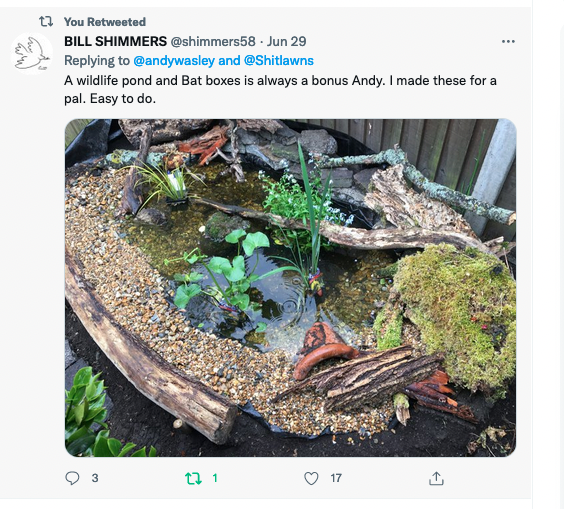
We were very influenced by this wonderful pond made by Bill Shimmers at the time of sowing the wild seeds (above) and added our own versions in a smaller and cheaper way utilising a slow cooker crock pot, a dutch pot that only had one handle and a tupperware box. An example of “down at heel” pond construction at its finest and nowhere as great as Bill’s. We are sure at the time Bill replied to our tweet at the time saying kindly that even the smallest addition of water in the garden will help the wildlife. What is great though yesterday we saw the odd frog in one, a drowned slug or two in the other and some very strange moving things that could have just been the “floaters” in our eyes playing up or the effects of dehydration. That was without our glasses on as well so there could well have been more stuff moving about.
As it was very cool down there for most of the day (compared to the 32 degrees C in the sun) we just started and kept on going, taking stuff away and adding the odd different plants and herbs we have about the garden already. We reckon it will be an ongoing project as we can see a couple of plants we want to take out but we don’t want it too sparse as the wildlife needs a hiding place. There was no plan, make it up on the spot gardening innit?
Enjoy the last couple of days of intense heat as we’re supposed to be going back to the early 20 degree C next week. Here’s to more wildlife in the garden.
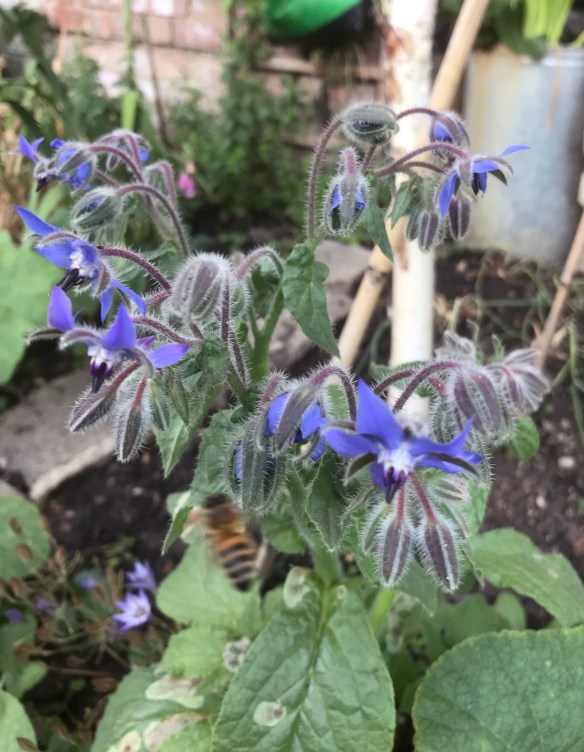
One plant we always have in the garden mainly through self seeding (thus being a volunteer plant) is the good herb borage. It’s great for the bees and its leaves can be thrown into the comfrey liquid bucket adding some extra goodness into the mix. More on its uses here.
Also if you remember we were a bit fed up of accidently leaving in potatoes when harvesting them and they regrow the year after leaving spuds where you don’t want spuds. One idea we were told about to get around this problem is growing them in a large pot, various containers and even plastic bags so all you have to do is tip the spuds and soil out in one easy action. Here’s one doing well (above) in a green shopping bag with lots of drainage holes in the bottom. Where there’s a will there’s a way as they say.
It’s been a while since we’ve heard about our friend (and musical collaborator) Paul Greenstein‘s garden in Melbourne, Australia. He’s sent us over a few pics and news of what he’s up to now. For around a year he’s been keeping bees.
“We started with a ‘nucleus’ hive, which is a small box with 5 frames. We’ve now grown to 3 full-sized boxes (supers), although we’ve packed the bees down into 2 boxes for the winter. For the bees, it’s about staying warm. From the beekeeper’s perspective, you want to make it easy for them to stay nice and toasty, and not to have to worry about heating a lot of empty space. Kind of like downsizing your house to save on the bills, except they keep warm by vibrating their flight muscles while keeping their wings still. Amazing little creatures.
We haven’t harvested any honey this time around, preferring to let the bees keep it for food during winter, building up a strong hive. We live very near a creek (basically a river, but not a very big one) – and there’s loads of stuff for bees to forage. Lots of Eucalypt trees, although there’s a particular type of Eucalypt called Stringybark or Messmate, which for some reason makes bees angry. Maybe they don’t like the way it smells. Hopefully they’ll avoid those and we won’t get stung by grumpy foragers…”
He also mentioned the subject of the last but one post about cicadas from Justin Patrick Moore:
“We get incredibly loud cicadas here – in fact they’ve been known to drown out conversation! Apparently the version we have here are called Greengrocer Cicadas, and can go up to 120 dB – louder than an ACDC gig. Our cats occasionally get fed up and swat them with a paw – they’ll go silent in shock for a few seconds, then start up again.”
Below is a pic of a Bramley apple that he’s put in as “You can’t get decent cooking apples over here!” We do like a cooking apple here especially in a crumble with custard! Do have a look at older posts about his garden here here and here.
And here’s a couple from Paul’s musical output, a lovely garden related tune called “Rose” that has a lovely ambient feel to it and one with a Jah Wobble type vibe called “White Blinds“, excellent stuff indeed!
As it says on his soundcloud “Sometimes inwards is the only way to go.” He and the bees are 100% correct! Cheers for the pictures Paul and keep us updated with how things are getting on!
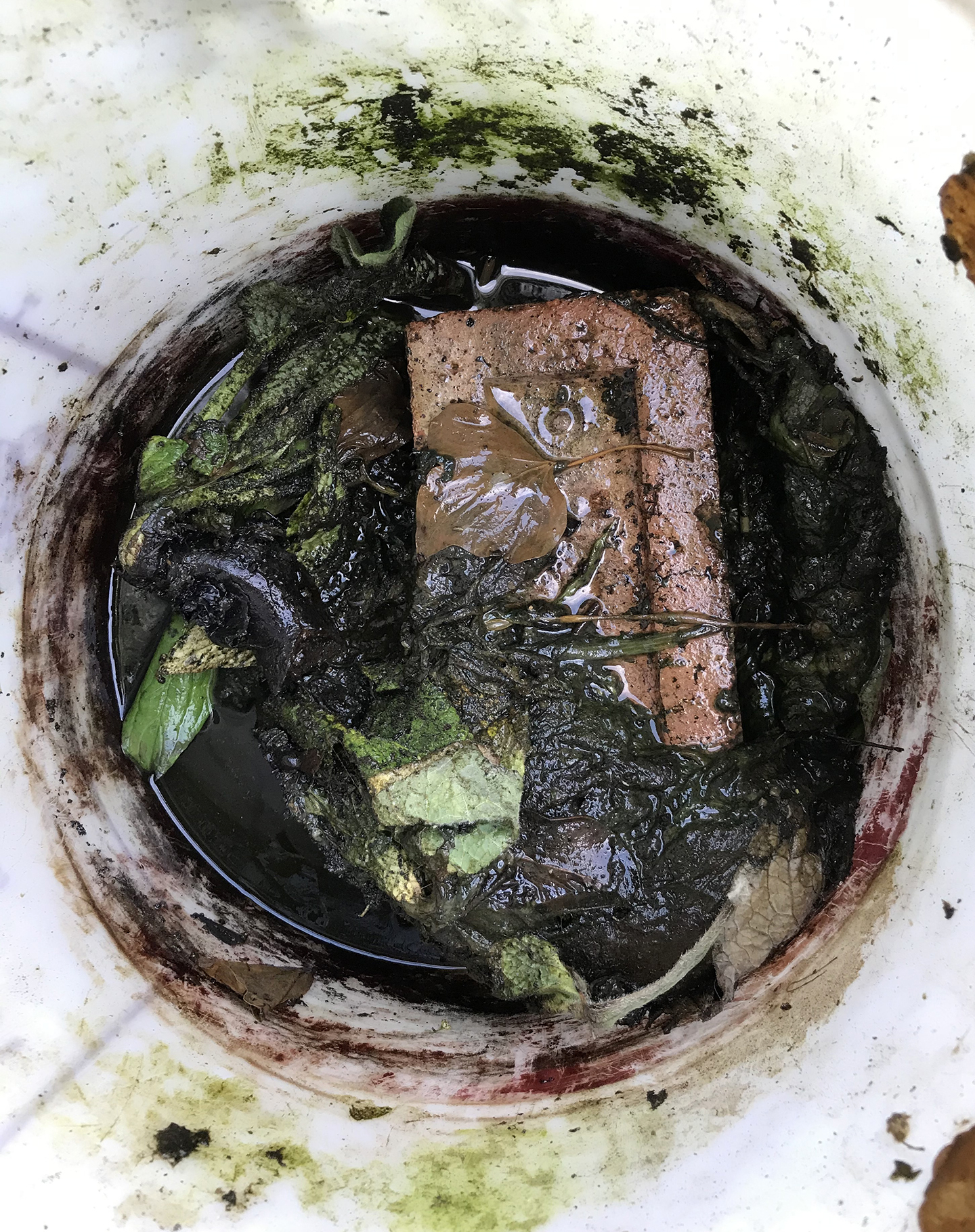
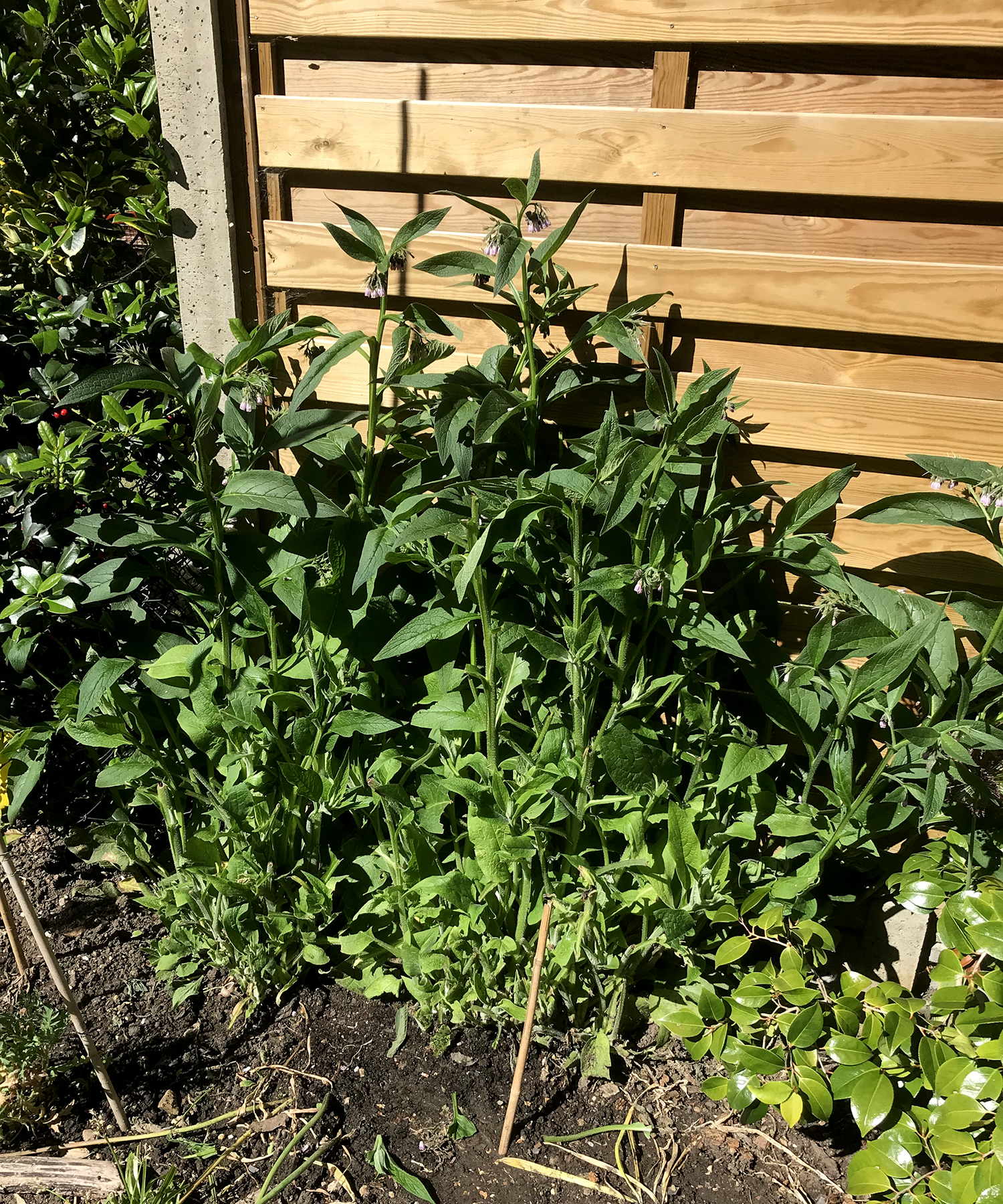
Comfrey liquid, don’t we all just love it? Looks awful don’t it? Well imagine the smell is about 1000 times worst as how it looks and you’re close. Drain out the liquid from the above abyss into a bottle then transfer a capful into a watering can and add some H20 and you’ll have some top end plant feed, we kid you not. As well as being bunged into a 1980’s Boot’s homebrew bucket we’re use a leaf or two to put below tomato plants (and other seedlings) before they go in the ground. A very versatile plant and the bees don’t half love it!
The actual plants where we’re taking the leaves from are taking a hammering at the moment (and it’s not even June!) but they don’t seem to mind. If you’re going to get some go for the “Bocking 14” variety. As the song goes: comfrey, what is it good for?
Big up to Simon and Paul from The Dirt (a gardening show like no other) for having a bit of a laugh with our Borage pronunciation debate on the show on Radio Fab International tonight.
Also a big shout to the show’s gardening expert/gentleman gardener Geoff Garrard for going for “bor-raj”, but we here are still sticking with “borridge” though! I mean it really don’t matter how we say it, the bees will still go mental for it!
The bees don’t care what it’s called but what do you think? The nation decides…
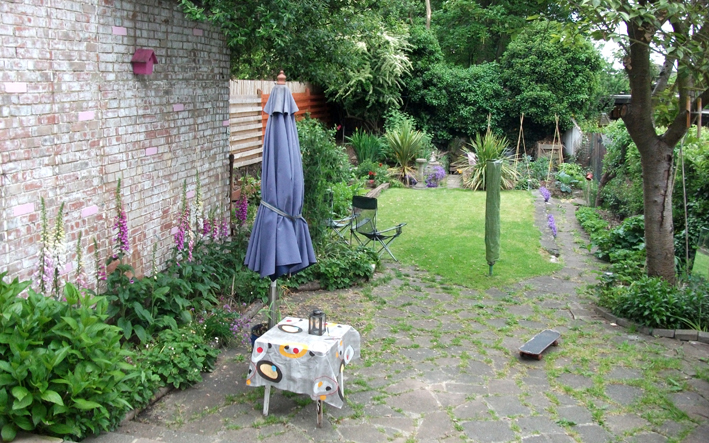
A view of the garden tonight taken while having a cup of char watching the Bees working their way around the Foxgloves on the left. It’s all starting to kick off growth-wise now!
I was feeling a bit overwhelmed today as it’s been a busy old week but it was only while listening to Wilko Johnson being interviewed on Radio 4 who was sounding well chipper even though he’s terminally ill that put all my moaning into perspective! I’ve never been a massive fan of Dr Feelgood but did see them at the Lanchester Polytechnic in the late 1970’s. A bloke who was doing the sound that night told us the band were really late arriving and so drunk they were turned away by the door staff thinking they were a gang of cockney blokes on a stag-night. It was only when a fan who was in the queue told the bloke on the door “You can’t do that mate, they’re the band!” Brilliant!
A big shout to our good gardening friend Scarlett (who also writes the excellent Heavenly Healer blog), who sent us an excerpt from her “Attracting Beneficial Insects” factsheet which she has kindly let us reproduce here. The following list applies to Bees and other beneficial insects.
March/April – Bluebell, Rosemary, Bugle and Dead-nettle
May/June – Aquilegia, Geranium, Campanula, Chives, Sages and Thymes, Wallflowers, Vipers bugloss, Birds foot trefoil and sweet peas.
July/August – Lavender, Cornflower and Centaurea, Marjoram and Scabious.
In general all insects love Sunflowers and Hollyhocks. Comfrey is great for the Bees (and for making liquid feed!) Monarda didyma, Linum, Agastache, Marjoram and Oregano, Astrantia, Thyme, Yarrow, Sage, Borage, Fuchsia, Geum, Cosmos, Poppy, Mallow, poached egg plant (Limnanthes douglasii) as well as climbing plants such as clematis and honeysuckle, are just a few examples in an exhaustive list.
Scarlett also let us know of a great exhibition currently at the V&A called From Club to Catwalk. Great stuff and great photo! Thanks for the list and the exhibition info. We’ll pop down over the summer for that. Talking of the summer, can we have the sunshine back?

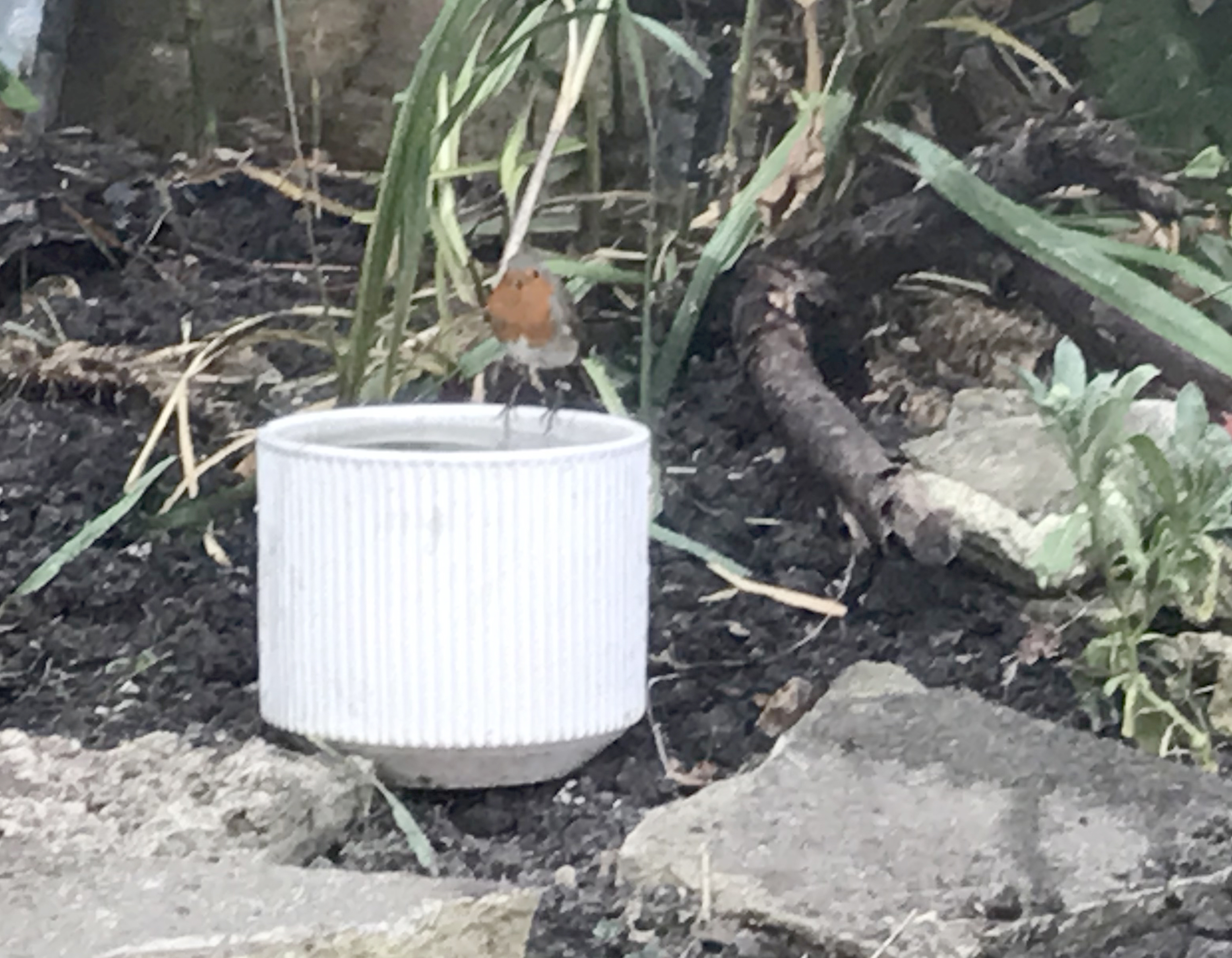
 Whilst having a cup of tea admiring our good work, we were visited by a fox quickly passing through, two birds including the Robin (top pic) and then a neighbour’s cat came in either for the birds or the bit of catmint we are growing near the pond. We remember years at Shannon’s someone telling us it will bring all the locals cats in. Perhaps they were right?
 This afternoon wandering around the garden we saw some bees going to town on a
  If we have to thin plants out of the pond we sometimes put them in micro ponds we’ve dug into the ground in the wild bit at the bottom of the garden. This time here’s some water mint in an old M&S plant container. Waste not want not.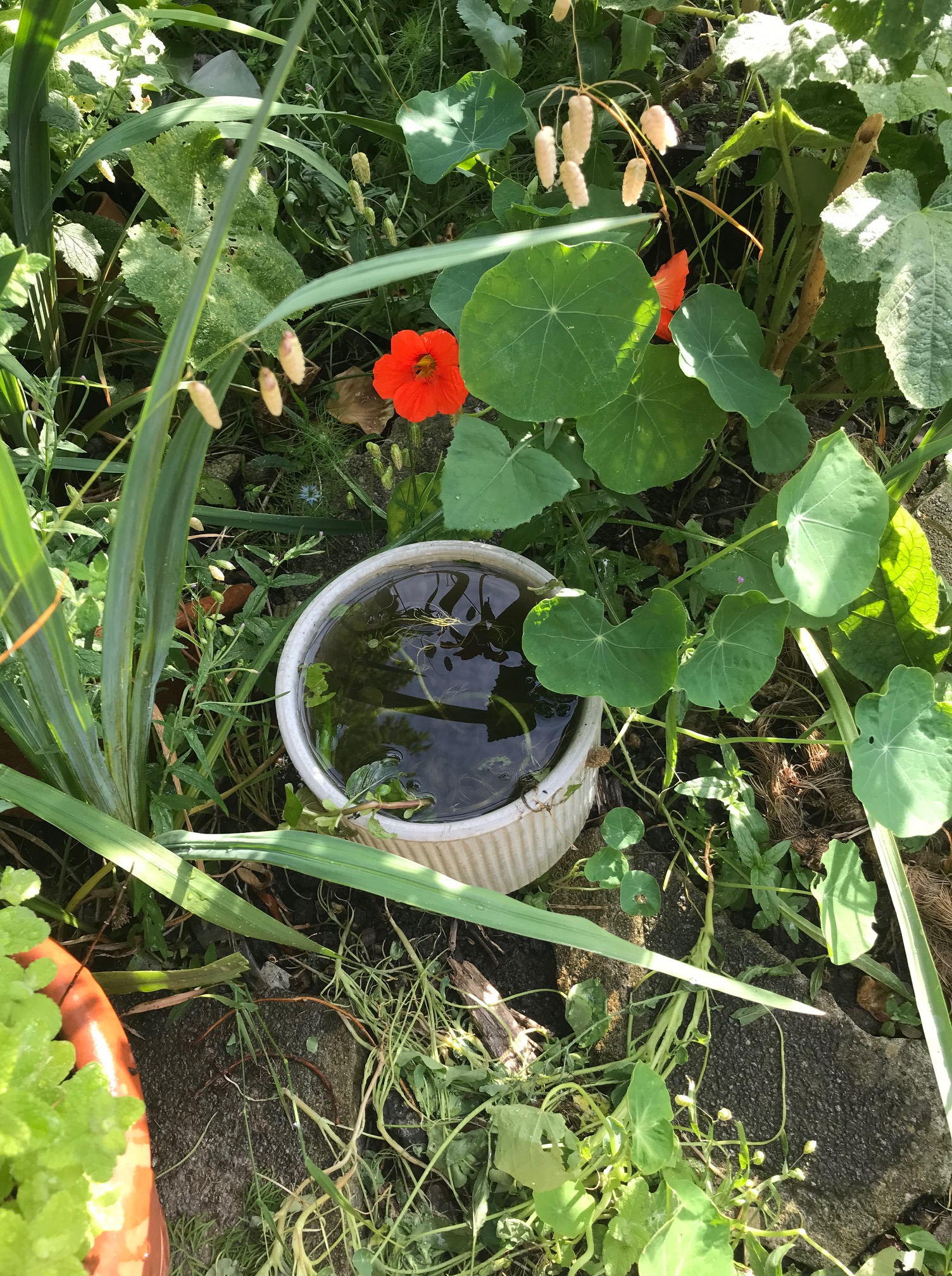
 “Honey bees get all the headlines” so it says on this great bee hotel/bee Air B&B seen by Guys & St Thomas’ Hospital the other day.
 If you remember, Paul keeps bees in his garden (above: a pic of his bees from a while ago) and he’s just recently had his first bumper crop of honey (below), extracting around 30 kilos and reckon they may be more as well. Great stuff Paul and thanks for letting us know about it, we imagine it’s very hard work but well worth it though.


 One plant we always have in the garden mainly through self seeding (thus being a


 The actual plants where we’re taking the leaves from are taking a hammering at the moment (and it’s not even June!) but they don’t seem to mind. If you’re going to get some go for the “Bocking 14” variety. As the song goes: comfrey, what is it good for?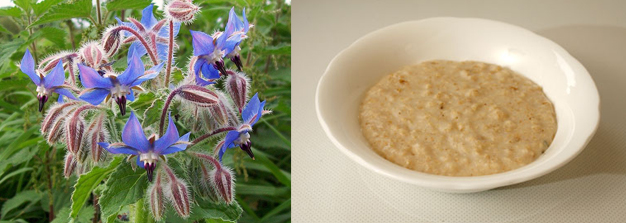

 Weeds up to me knees